
 Call us :
  Mail us to:


 English
 中文简体
中文简体

Product Knowledge
The Coil Coating Process: How PPGI Paint Systems Are Applied at the Mill
Pre-painted galvanized steel sheet is produced through a continuous coil coating process — one of the most controlled and technically sophisticated surface finishing methods in the metals industry. Unlike post-fabrication painting, where coatings are applied to finished parts with all their edges, joints, and geometrical complexity, coil coating applies paint to flat strip steel running at speeds of 60–200 meters per minute before any forming or cutting takes place. This controlled industrial environment consistently delivers film thickness tolerances, adhesion values, and color uniformity that field or batch painting simply cannot match.
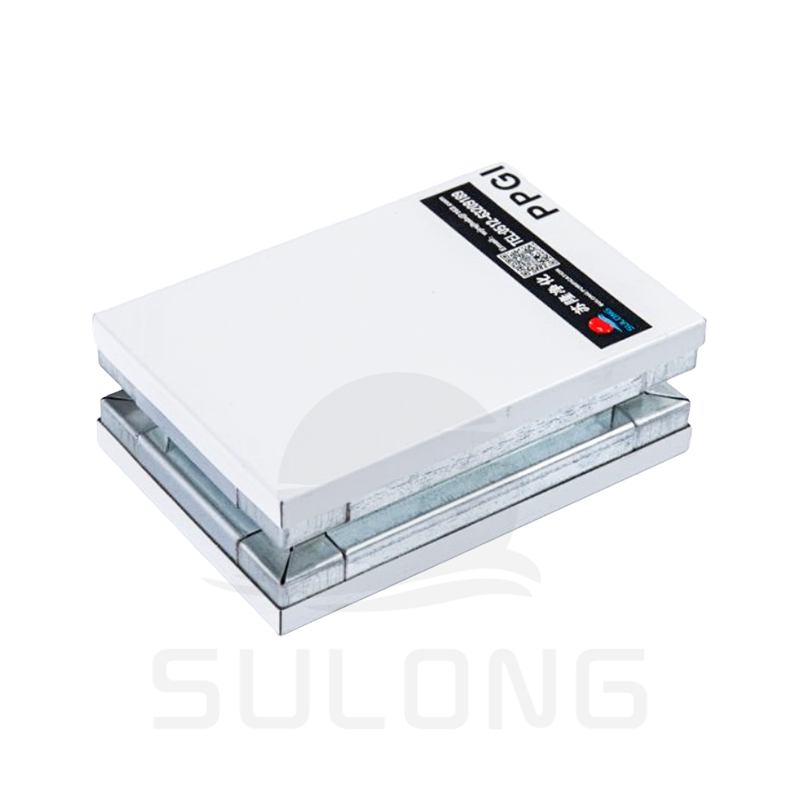
The process sequence begins with surface preparation: the galvanized steel strip is cleaned of oils and residues, then chemically pre-treated — typically with a chromate-free conversion coating based on titanium/zirconium chemistry, which creates a micro-textured phosphate or oxide layer that dramatically improves paint adhesion and provides additional corrosion inhibition at the interface. A primer coat (typically 5–8 μm dry film thickness) is then applied by roller coater, cured in a peak metal temperature (PMT) oven at 200–240°C, and the strip is cooled before the topcoat is applied by a second roller station. The topcoat, typically 15–25 μm, is similarly oven-cured and then quenched. The back side of the strip receives its own primer and backcoat in a parallel sequence. The result is a factory-finished panel with a fully cured, chemically bonded paint system where every layer is applied under calibrated conditions — which is exactly what makes our PPGI sheets deliver consistent surface quality and uniform color across every coil and every order.
Paint System Types Used in PPGI and How to Choose Between Them
The topcoat chemistry of a PPGI sheet determines most of its performance characteristics in service — UV resistance, flexibility, chemical resistance, temperature tolerance, and service life. Different resin systems have distinct performance profiles, and matching the correct system to the intended application environment prevents premature coating failure. The four main topcoat chemistries used in coil-coated PPGI are polyester (PE), silicon-modified polyester (SMP), high-durability polyester (HDP), and polyvinylidene fluoride (PVDF).
| Topcoat Type | Typical DFT | UV Resistance | Flexibility | Typical Service Life (outdoor) | Best Application |
| Standard Polyester (PE) | 15–20 μm | Moderate | Good | 10–15 years | Interior panels, low-exposure cladding |
| Silicon-Modified Polyester (SMP) | 20–25 μm | Good | Moderate | 15–20 years | General roofing, agricultural buildings |
| High-Durability Polyester (HDP) | 25–35 μm | Very Good | Good | 20–25 years | Commercial facades, coastal environments |
| PVDF (Polyvinylidene Fluoride) | 25–27 μm | Excellent | Moderate | 30+ years | Architectural facades, high-UV, marine zones |
PVDF coatings (marketed under brand names such as Kynar 500 or Hylar 5000) contain 70–80% PVDF resin with 20–30% acrylic binder. The carbon-fluorine bond in PVDF is one of the strongest in organic chemistry, giving these coatings exceptional resistance to UV photodegradation, chalking, and color fade. However, PVDF is less flexible than polyester systems, which limits the forming radii achievable in roll-forming without cracking. For cleanroom walls and controlled environment ceiling panels — where UV durability matters less than chemical resistance and cleanability — a high-quality standard or high-durability polyester system at adequate film build is the appropriate specification, delivering cost efficiency without sacrificing the surface integrity that matters most in service.
Understanding PPGI Coating Thickness: Why Nominal DFT Is Not the Whole Story
Dry film thickness (DFT) is the single most frequently cited coating specification for PPGI, yet it is widely misunderstood — particularly when comparing nominal DFT values across suppliers and standards. DFT is measured using magnetic induction gauges (for non-magnetic coatings on steel) and is subject to measurement variability across a coil due to roller pressure variations, coating viscosity changes during a production run, and the inherent edge thinning effect where paint slightly recedes from strip edges during curing. Specifying a nominal DFT without a minimum DFT and a measurement sampling plan is therefore an incomplete specification.
EN 10169 — the primary European standard for continuously organic-coated flat-rolled steel — distinguishes between nominal coating thickness, minimum local thickness (typically 80% of nominal), and minimum mean thickness (typically 90% of nominal). A PPGI sheet specified as "20 μm nominal PE topcoat" to EN 10169 guarantees a minimum local measurement of 16 μm at any single point and a mean of 18 μm across the measurement population. Buyers who specify only "20 μm" without referencing this standard allow suppliers to average measurements across thick and thin zones in ways that may include areas with 12–13 μm film build — insufficient for the corrosion and cleanability performance expected. Always specify DFT in conjunction with the applicable standard and minimum local thickness requirement when sourcing PPGI for performance-critical applications.
The Relationship Between DFT, Gloss Level, and Surface Cleanability
Gloss level (measured at 60° geometry per ISO 2813) affects not only the aesthetic character of a PPGI surface but also its practical cleanability. High-gloss surfaces (60° gloss units ≥70 GU) have lower surface roughness (Ra typically 0.1–0.3 μm) and present less mechanical retention area for particulate contamination and microbial biofilm — which is why our PPGI sheets specified for cleanroom wall and ceiling applications feature smooth, high-gloss or satin-gloss finishes. However, high-gloss surfaces more visibly show scratches, handling marks, and minor coating defects. Matt or textured finishes (10–30 GU) hide surface damage more effectively but accumulate contamination in their micro-topography. For environments where both hygiene and long-term appearance are priorities — pharmaceutical manufacturing, hospital operating suites, food processing facilities — a satin finish in the 35–55 GU range is frequently the best compromise between cleanability and defect tolerance.
PPGI Color Specification: RAL, CIELAB, and Batch-to-Batch Color Consistency
Color specification for PPGI in architectural and industrial applications involves more precision than selecting a RAL number from a fan deck. RAL codes describe color families, not absolute colorimetric targets — the same RAL 9002 (Grey White) can have measurably different spectral reflectance values from different paint formulators, and the difference is visible when panels from different production batches are installed side by side. For projects where color consistency across large panel areas is critical — cleanroom ceilings, hospital corridors, commercial facades — a colorimetric specification using CIELAB (L*, a*, b*) values with defined tolerance limits is the technically correct approach.
CIELAB quantifies color as three coordinates: L* (lightness, 0=black to 100=white), a* (red-green axis), and b* (yellow-blue axis). The total color difference between two panels is expressed as ΔE (delta-E), calculated as the Euclidean distance between their L*a*b* coordinates. Human eyes begin to perceive color differences at ΔE values around 1.0–2.0 in direct adjacent comparison under controlled lighting; differences above ΔE 3.0 are typically noticeable to non-expert observers. For PPGI in architectural applications, a specification requiring ΔE ≤ 1.5 between any panel and the target standard, tested per ISO 7724 under D65 illuminant at 10° observer angle, provides a reliable basis for procurement and quality acceptance. Mill test certificates for PPGI coils should include L*a*b* values measured on production output for traceability.
Corrosion Performance Testing for PPGI: What Salt Spray Hours Actually Mean
Salt spray testing (neutral salt spray, NSS, per ISO 9227 or ASTM B117) is the most frequently cited corrosion performance test for coated steel products, and its results are often misrepresented or misunderstood in commercial contexts. The test exposes coated samples to a continuous mist of 5% NaCl solution at 35°C in a closed chamber and evaluates how long the coating resists rust creep from a scribe mark and face blistering. While it provides useful comparative data between coating systems under standardized conditions, there is no reliable direct conversion between salt spray hours and years of real outdoor service life.
The mechanisms of accelerated salt spray corrosion differ from field corrosion in several important ways: constant wetness, no UV exposure, no freeze-thaw cycling, and no real pollutant chemistry. Salt spray ranking correlates well with relative coating performance but not with absolute service life predictions. A PPGI coating achieving 500 hours NSS without scribe creep exceeding 1 mm does not mean it will last 500 hours' equivalent in outdoor service — it might last 10 years or 25 years depending on climate, application design, and maintenance. For more realistic accelerated test data, cyclic corrosion tests such as ISO 11997-1 (Cycle A or B), the GMW14872 automotive prohesion test, or the Kesternich SO₂ humidity test (ISO 6988) provide better correlation to real atmospheric exposure performance, particularly for PPGI used in industrial environments where acid precipitation is a factor.
The Critical Role of the Primer in PPGI Corrosion Resistance
The primer layer in a PPGI coating system carries a disproportionate share of the corrosion protection function relative to its thickness. Coil coating primers for PPGI are typically 5–8 μm thick — far thinner than the topcoat — but they contain active corrosion-inhibiting pigments (historically chromate-based, now chromate-free alternatives such as strontium chromate substitutes, zinc phosphate, or organic inhibitors) that provide anodic or cathodic inhibition at the zinc-primer interface. When a PPGI surface is scratched or cut, the primer's inhibitor chemistry migrates in the presence of moisture to passivate the exposed metal surface, slowing the onset of corrosion at the damage point. A PPGI sheet with a high-quality inhibited primer but an average topcoat will outperform a sheet with a thick, high-durability topcoat over a basic non-inhibited primer in field corrosion resistance — the primer is the system's backbone, not the topcoat thickness.
PPGI in Cleanroom and Controlled Environment Construction: Technical Fit and Specification
Cleanrooms and controlled environments impose a specific and demanding set of requirements on wall and ceiling cladding materials that standard architectural PPGI may or may not meet depending on its specification. The relevant performance criteria extend well beyond corrosion resistance and aesthetics — they include particle generation, chemical resistance to cleaning agents, electrostatic behavior, and joint system compatibility with the cleanroom envelope's air tightness and pressure requirements.
Particle generation — the tendency of a surface to release particles into the cleanroom environment under abrasion, vibration, or cleaning — is minimized in PPGI by the fully cross-linked, hard topcoat surface of a properly cured coil coating. Unlike painted plasterboard or site-applied coatings, which can chalk, flake, or release particles as they age, a factory-cured PPGI topcoat maintains its surface integrity across the coating's full service life without particle shedding under normal operational conditions. This particle-inert characteristic is one of the fundamental reasons our PPGI sheets are widely specified for cleanroom walls and ceilings in pharmaceutical manufacturing and semiconductor fabrication facilities, where ISO 14644-1 cleanliness classifications require strict control over particulate contamination sources.
- Chemical resistance to disinfectants: Cleanroom cleaning protocols involve repeated application of IPA (isopropyl alcohol), hydrogen peroxide vapor (HPV), quaternary ammonium compounds, and oxidizing agents. PPGI topcoats based on high-durability polyester or modified polyester systems show good resistance to these agents at standard use concentrations. Suppliers should provide chemical resistance test data specific to the disinfectant chemicals used at the target facility — generic "chemical resistant" claims are insufficient for pharmaceutical GMP environments where cleaning validation is a regulatory requirement.
- Electrostatic dissipation (ESD): In semiconductor cleanrooms and some electronics manufacturing facilities, standard PPGI surfaces can accumulate electrostatic charge that attracts particles and potentially damages sensitive components. ESD-grade PPGI is produced by incorporating conductive carbon black or metallic pigment into the topcoat formulation to achieve a surface resistivity of 10⁶ to 10⁹ Ω/square — the range defined as electrostatic dissipative per IEC 61340-4-1. Standard PPGI without ESD treatment has surface resistivity above 10¹² Ω/square and is not appropriate for ESD-controlled areas.
- Fire performance: PPGI panels used in cleanroom construction must meet fire reaction classifications applicable to the facility type and national building code. In European markets, ISO 1182 and EN 13501-1 classifications apply; PPGI typically achieves Class B-s1-d0 or Class C depending on panel thickness, substrate, and topcoat chemistry. Some pharmaceutical cleanroom projects require Class A2 or better, which may necessitate a mineral-core sandwich panel system rather than a simple PPGI sheet.
- Hygienic joint systems: The performance of PPGI in cleanroom applications depends as much on the joint and fixing detail as on the panel properties. Exposed cut edges, open joints, and silicone-filled gaps can harbor contamination even when the PPGI surface itself is fully cleanable. Purpose-designed aluminum extrusion jointing systems with coved internal profiles — which eliminate 90-degree internal corners that cannot be fully cleaned — are the standard detail for pharmaceutical and food-grade cleanroom PPGI installations.
Formability of PPGI: How Paint Systems Behave During Roll Forming and Bending
A key advantage of Pre-painted Galvanized Steel Sheet (PPGI) is that the coil-coated paint system is specifically formulated for post-coat forming — the sheet is painted flat and then roll-formed or bent into its final profile. This requires the paint system to maintain adhesion and crack resistance through the plastic deformation of forming, which imposes tensile strain on the outer radius of bends and compressive strain on the inner radius. The formability of a PPGI coating is quantified by the T-bend test (ISO 1519 / ASTM D4145), which measures the minimum bend radius expressed as multiples of sheet thickness (0T, 1T, 2T, etc.) at which the coating shows no cracking or adhesion loss when examined under 10× magnification.
Standard polyester PPGI coatings typically achieve 0T to 1T formability — meaning they can be bent back on themselves without cracking, which is sufficient for most roll-formed roofing and wall panel profiles. PVDF coatings have lower elongation at break and typically achieve 1T to 2T formability, which limits their use in profiles with very tight bend radii. Thicker paint systems (above 35 μm total) are generally less formable than standard systems because the increased film mass creates higher internal stresses at bends. For complex profiles with multiple tight-radius folds — such as those used in sandwich panel edge details and cleanroom corner trim components — the formability performance of the PPGI paint system must be verified against the specific forming geometry before production commitment.
Cut Edge Corrosion Protection in Formed PPGI Components
When PPGI is cut — whether by shearing, slitting, plasma, or laser — the cut edge exposes the bare galvanized steel substrate with no paint coverage. The corrosion protection at cut edges relies entirely on cathodic protection from the adjacent zinc coating and, to a lesser extent, on migration of inhibitor pigments from the primer. The cathodic protection radius of the zinc layer extends approximately 1–3 mm from the coating edge into the bare steel zone, which is adequate for most indoor and mild outdoor applications. In marine environments, industrial atmospheres rated C4 or C5 under ISO 9223, or in applications where cut edges are in direct contact with condensation or standing water, the cathodic protection range may be insufficient, and additional edge protection — zinc-rich cold spray, sealant beads, or aluminum edge trim — should be designed into the installation detail. This is particularly relevant for PPGI roofing panels where cut rake edges are exposed to wind-driven rain without any cover flashing.
Sustainability and Environmental Credentials of PPGI in Building Applications
PPGI's sustainability profile is frequently evaluated only in terms of its raw material content — steel (recyclable), zinc (recyclable), and organic paint (petroleum-derived, not recyclable in conventional streams). This single-dimension assessment undervalues the lifecycle impact of the material's durability and the resource efficiency of the coil coating manufacturing process compared to site-applied alternatives.
Coil coating is inherently a low-waste process: solvent recovery systems recapture and recycle volatile organic compounds (VOCs) from oven exhaust streams, with many modern lines achieving VOC recovery rates above 95%. The result is that coil-coated PPGI has a significantly lower VOC emission profile per square meter of finished surface than site-applied liquid paint systems, and essentially zero VOC emission in service after curing — an important consideration for cleanrooms and occupied buildings where indoor air quality is regulated. Environmental Product Declarations (EPDs) produced to EN 15804 are available from major PPGI producers and provide transparent lifecycle assessment data on global warming potential, resource consumption, and end-of-life scenarios. The steel substrate is 100% recyclable at end of life through standard steel recycling streams; the paint coating is incinerated as part of the steel melting process with energy recovery rather than landfilled.
From a lifecycle carbon perspective, the key variable is service life. A PPGI roofing or wall panel with a 25-year design service life before requiring replacement generates substantially lower annualized carbon impact than a painted plasterboard system requiring redecoration every 5–7 years or a vinyl-faced panel system with a 15-year service life. The reduced maintenance cycles — no repainting, no surface preparation, no scaffolding or production downtime — also represent operational cost and carbon savings that are rarely quantified in initial material comparisons but are very real over the building lifecycle. This is precisely why specifying our PPGI sheets in long-service-life applications translates directly into measurable reductions in both total cost of ownership and environmental impact over the project's operational period.


