
 Call us :
  Mail us to:


 English
 中文简体
中文简体

Product Knowledge
How High Pressure Laminate Is Actually Made — and Why the Process Matters
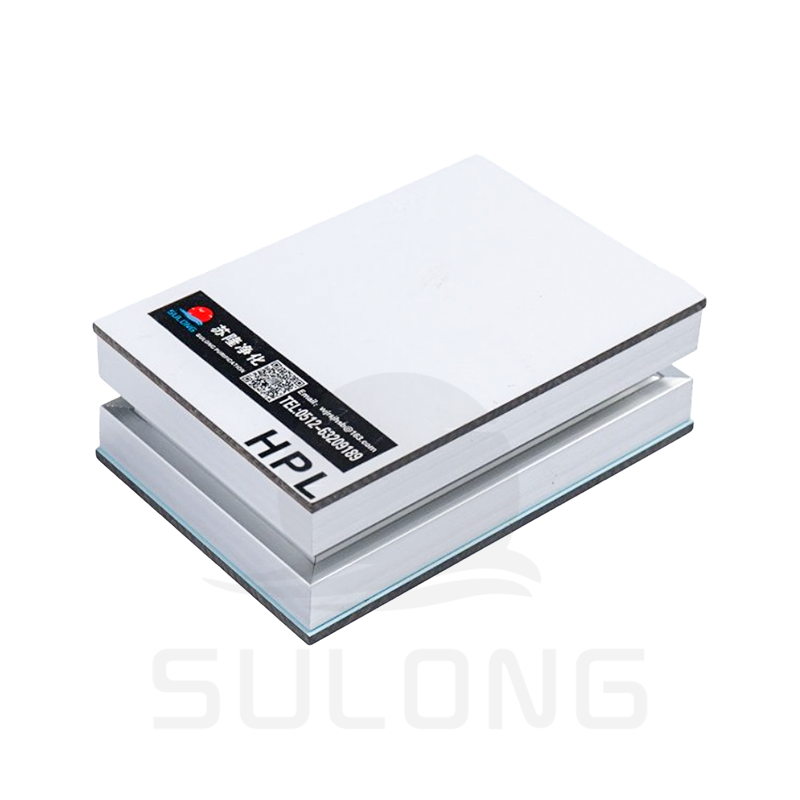
High Pressure Laminate panels are produced through a thermosetting process that permanently fuses multiple layers of kraft paper, a decorative layer, and a protective overlay using heat and pressure. The kraft paper layers are first saturated with phenolic resin — a thermosetting polymer that becomes rigid and irreversible when cured. The decorative layer, which carries the visible color or pattern, is impregnated with melamine resin, which is harder and more transparent. These stacked layers are then consolidated in a multi-daylight hydraulic press at pressures typically between 5.5 and 11.5 MPa and temperatures around 120–160°C for a defined cure cycle.
This high-pressure cure is what distinguishes HPL from low-pressure laminate (LPL or thermally fused laminate), where a single resin-impregnated layer is simply bonded to a substrate under much lower pressure. In HPL, the cross-linking of phenolic and melamine resins under pressure creates an interpenetrating polymer network that is chemically stable, dimensionally dense, and mechanically robust. The cured panel is no longer responsive to its individual component materials — it behaves as a unified composite with properties neither paper nor resin alone could achieve. The number of kraft paper core layers directly influences panel thickness and stiffness; standard decorative HPL sheets range from 0.6 mm to 1.5 mm, while compact HPL — a self-supporting structural grade — ranges from 2 mm to 25 mm or more.
Compact HPL vs. Standard HPL Sheets: Choosing the Right Form Factor
The distinction between standard decorative HPL sheets and compact HPL panels is frequently misunderstood, and choosing the wrong form factor for an application leads to either structural failure or unnecessary cost. Standard HPL sheets are thin (typically 0.6–1.5 mm), require bonding to a substrate (particleboard, MDF, or plywood) to function as a panel, and are used primarily for surfacing furniture, cabinetry, and wall cladding systems where the substrate provides structural support. Compact HPL, by contrast, is a through-body panel built from many more core layers, making it self-supporting without any substrate backing.
Compact panels are the correct choice for applications requiring the panel itself to carry loads, span distances, or resist moisture penetration through the cross-section — toilet cubicles, laboratory benchtops, cleanroom wall panels, locker systems, and exterior cladding all fall into this category. Because compact HPL has decorative laminates pressed onto both faces simultaneously, it also avoids the differential expansion and moisture absorption problems that arise when a single-sided laminated substrate warps due to unbalanced construction. For environments where hygiene control is critical — such as the pharmaceutical cleanrooms and healthcare facilities our HPL panels are specifically engineered for — compact form eliminates the substrate edge exposure where moisture and bacteria could otherwise accumulate.
Reading HPL Performance Standards: What EN 438 and Other Certifications Actually Tell You
EN 438 is the primary European standard governing HPL quality, and it is referenced globally as a benchmark even outside European markets. The standard divides HPL into types and grades based on application and thickness, with each grade assigned a specific set of minimum performance values across a defined battery of tests. Understanding which grade applies to your use case prevents both over-specification (paying for performance you don't need) and under-specification (selecting a panel that will fail in service).
| EN 438 Type | Description | Typical Thickness | Primary Application |
| Type HGS | Horizontal general purpose | 0.6–1.0 mm | Furniture surfaces, worktops bonded to substrate |
| Type HGP | Vertical general purpose | 0.6–0.8 mm | Wall cladding, door facings, vertical panels |
| Type CGS | Compact general purpose | 2–25 mm | Self-supporting panels, lab benches, cubicles |
| Type EDF | Exterior façade grade | 6–12 mm | Rainscreen cladding, ventilated facades |
| Type SHL | High abrasion / flooring grade | 0.8–1.2 mm | Flooring overlays, high-traffic horizontal surfaces |
Beyond EN 438, specifiers in controlled environments should look for additional certifications relevant to their sector. ISO 10993 biocompatibility testing is relevant for panels in direct patient contact zones. GREENGUARD Gold certification verifies low VOC emissions — critical in sealed cleanrooms and hospitals where air quality is tightly controlled. NSF/ANSI 51 covers food equipment surface materials. When we specify HPL panels for healthcare and laboratory environments, we ensure compliance with the relevant subset of these standards rather than relying on EN 438 alone, because the standard was written for general building applications, not for controlled-environment hygiene performance.
Chemical Resistance in Practice: What "Resistant" Actually Means for HPL Surfaces
The term "chemical resistance" on an HPL data sheet requires careful interpretation. Resistance ratings are typically tested by applying a defined chemical at a defined concentration to the surface for a defined contact time, then evaluating for color change, gloss change, swelling, or surface softening. A panel rated as "resistant" to a chemical under the test protocol may still show damage if the chemical is applied at higher concentration, left in prolonged contact, or used at elevated temperatures — all conditions that occur in real cleaning and disinfection workflows.
For healthcare and laboratory environments, the chemicals of concern fall into several categories: oxidizing agents (hydrogen peroxide, peracetic acid, sodium hypochlorite/bleach), quaternary ammonium compounds (QACs), phenolic disinfectants, aldehydes (glutaraldehyde, formaldehyde), and alcohols (isopropanol, ethanol). HPL surfaces perform differently against each. Alcohols and QACs are generally well tolerated at standard disinfection concentrations. Hypochlorite at concentrations above 1,000 ppm used frequently can cause surface whitening and micro-etching over time on standard HPL grades. Phenolics and high-concentration peroxides pose greater risk. Our panels are formulated and tested against the specific disinfectant profiles used in pharmaceutical manufacturing and healthcare settings — because resistance to a generic list of chemicals is less useful than documented performance against the actual agents your facility uses.
The Role of Surface Texture in Cleanability
Surface texture has a direct and often underestimated effect on cleanability and microbial retention independent of chemical resistance. Rough or embossed HPL textures may offer aesthetic appeal or slip resistance, but they also create micro-recesses where organic material accumulates and where disinfectants have reduced contact with all surface features. In high-hygiene environments, smooth or low-texture surfaces (gloss or satin finish, Ra below 0.5 μm) are strongly preferred because they allow cleaning agents to contact the entire surface geometry without mechanical scrubbing to access recesses. EN ISO 4287 defines surface roughness parameters; specifiers should request Ra values from HPL suppliers rather than relying on descriptive finish names, which are not standardized across manufacturers.
Abrasion Resistance Ratings and What They Predict About Surface Longevity
HPL abrasion resistance is quantified using the Taber abrasion test (ASTM D4060 or EN 438-2 Test 14), which measures the number of cycles a standardized abrasive wheel requires to wear through the decorative surface to expose the core. The result is reported in cycles (IP — Initial Point, where the pattern first shows wear) and as a wear value in mg/100 cycles. For context: standard decorative HPL achieves 150–400 IP cycles; high-abrasion horizontal-grade HPL (used in flooring overlays and high-traffic work surfaces) reaches 2,000–4,000 IP cycles. Flooring-grade HPL used in AC4/AC5 laminate flooring systems achieves 9,000+ cycles.
In cleanroom and laboratory wall panel applications, abrasion resistance matters not because walls are abraded by foot traffic, but because surfaces are repeatedly cleaned with wipers, sponges, and mechanical cleaning devices — particularly in ISO Class 5–7 cleanrooms where cleaning protocols are aggressive and frequent. A surface that shows visible wear within 12–18 months of service loses both its aesthetic integrity and, more importantly, begins to develop surface micro-roughness that compromises cleanability. High abrasion resistance in our HPL panels directly translates to surface integrity maintained over a long service life, which is one of the primary reasons facilities report reduced maintenance and replacement expenditure compared to alternatives like painted surfaces, vinyl cladding, or lower-grade laminates.
HPL Panel Jointing Systems and Why the Detail Matters More Than the Panel Itself
In high-hygiene environments, the performance of an HPL wall system is often determined not by the panel itself but by the jointing and edge detail. An HPL panel with excellent chemical resistance and low surface roughness provides no hygiene benefit if it is installed with open joints, exposed core edges, or silicone sealant joints that harbor biofilm. This is one of the most critical and frequently underspecified aspects of cleanroom and healthcare wall system design.
Concealed vs. Expressed Joint Systems
Expressed joint systems use visible aluminum or stainless steel profiles to connect adjacent panels, creating a consistent geometric grid on the wall face. These are widely used in pharmaceutical cleanrooms because the joints are accessible for cleaning, inspectable, and do not rely on sealants that degrade over time. The profile design should be coved or rounded at the wall interface rather than creating a 90-degree internal corner, which is impossible to clean completely. Concealed fixing systems, which attach the panel from behind using a subframe and clip system, provide a flush surface with no visible fastener but require access panels for inspection and maintenance of services behind the wall system.
Edge Treatment and Core Exposure
The kraft paper core of standard High Pressure Laminate (HPL) Panel is hydrophilic and will absorb moisture if exposed at cut edges, leading to swelling, delamination, and microbial growth. Compact HPL panels for wet environments should have all cut edges sealed — either by the manufacturer applying an edge banding of compatible material, by field application of edge sealant, or by the panel design routing edges away from moisture exposure zones. In food processing facilities and pharmaceutical cleanrooms, the preferred approach is an integrated aluminum edge profile that mechanically covers the core and provides a sealed, cleanable surface regardless of the condition of the HPL edge itself.
Thermal and Dimensional Stability: Managing HPL Movement in Controlled Environments
HPL is an anisotropic material — it expands and contracts differently in the machine direction versus the cross direction, and it responds to changes in both temperature and relative humidity. For most interior applications, this movement is minor and easily managed by standard installation practices. In controlled environments like cleanrooms and laboratories, however, the conditions create specific challenges that require deliberate attention during design and installation.
Cleanrooms typically maintain tightly controlled temperature (often 20–22°C ±1°C) and relative humidity (45–55% RH ±5%). This stability actually benefits HPL performance — the material experiences less dimensional cycling than in uncontrolled environments. However, during construction and before environmental control is commissioned, panels may be installed at ambient conditions significantly different from operational conditions. If panels are fixed without adequate expansion allowance during this pre-commissioning phase and then the environment is brought to cleanroom conditions, differential movement between the HPL panel and its substrate or fixing frame can generate stresses that cause surface buckling or joint opening. The standard recommendation is to allow HPL panels to acclimatize to the installation environment for at least 48 hours before fixing, and to design fixing systems with appropriate movement allowances — typically 1.5 to 2.0 mm per meter of panel length for temperature and humidity ranges commonly encountered during construction.
Fire Performance Classifications for HPL in Regulated Environments
Fire performance requirements for interior wall and ceiling cladding materials are among the most strictly regulated aspects of building specification, and healthcare facilities, laboratories, and pharmaceutical manufacturing buildings are subject to some of the most demanding fire classifications in building codes globally. HPL panels span a wide range of fire performance — from standard grades with no special treatment to specially formulated fire-retardant compact panels achieving the highest reaction-to-fire classifications.
- Euroclass B-s1-d0: This classification under EN 13501-1 indicates that the material has limited combustibility (Class B), produces very low smoke (s1), and produces no flaming droplets or particles (d0). This is the most common minimum specification for wall cladding in healthcare corridors, operating theatres, and pharmaceutical production zones in European-regulated markets. Standard HPL without fire treatment typically achieves Class C or D; achieving Class B requires specific resin formulation or fire-retardant core impregnation.
- ASTM E84 Class A (Flame Spread Index ≤25): The North American equivalent test for surface burning characteristics. Class A is required for HPL used in healthcare occupancies under the NFPA 101 Life Safety Code and IBC Section 803. Standard HPL often achieves Class B (FSI 26–75); fire-rated HPL specifically formulated for healthcare applications achieves Class A.
- Impact of substrate on system classification: Fire performance testing of HPL is conducted on the complete system — panel plus substrate plus fixing method — not on the HPL sheet alone. A panel achieving B-s1-d0 in the tested configuration may perform differently when bonded to a different substrate or installed with air gap. Specifiers should request system test certificates, not just panel certificates, when fire classification is a regulatory requirement.
- Smoke toxicity considerations: In healthcare facilities where occupants may have limited mobility or be unable to self-evacuate, smoke toxicity is as significant as flame spread. The s1 smoke classification in the Euroclass system addresses smoke production rate but not chemical toxicity of combustion gases. Some specifiers additionally require testing under BS 6853 or NF X70-100 for smoke toxicity in healthcare applications — a requirement not covered by EN 13501-1 alone.
Sustainability Credentials of HPL: What the Data Shows
Sustainability assessment of HPL requires a full lifecycle perspective rather than a single-metric evaluation. HPL is composed primarily of paper (a renewable resource) and thermosetting resins (petroleum-derived and non-recyclable in conventional streams). The manufacturing process is energy-intensive. However, HPL's durability profile fundamentally changes its lifecycle environmental impact relative to lower-durability alternatives.
Environmental Product Declarations (EPDs) produced in accordance with EN 15804 and ISO 14044 provide the most reliable comparative data. Published EPDs for compact HPL from major manufacturers typically show a global warming potential (GWP) of 2.0–3.5 kg CO₂ equivalent per square meter of 10 mm panel — a figure that needs to be assessed against service life. A compact HPL panel with a 30-year service life in a hospital corridor generates significantly lower annualized environmental impact than a painted plasterboard system requiring repainting every 3–5 years or a PVC cladding system with a 15-year service life. The reduced maintenance cycles — no repainting, minimal replacement — are also directly relevant to the operational carbon footprint of facilities that must be partially shut down or decontaminated during maintenance works.
At end of life, HPL panels cannot be recycled through mainstream material streams due to their thermoset matrix. However, some manufacturers offer take-back programs where post-use HPL is processed as a fuel substitute (refuse-derived fuel) in cement kilns, recovering the energy value of the resin content. Forest Stewardship Council (FSC) certification on the paper fiber content is available from most major HPL producers and provides chain-of-custody documentation for projects requiring sustainable material sourcing credentials under LEED, BREEAM, or equivalent rating systems.


