
2026-07-30
Cleanrooms rely on a constant, controlled flow of filtered air to keep particles, dust, and contaminants away from sensitive processes. Whether it's semiconductor manufacturing, pharmaceutical production, or biotech research, the equipment responsible for delivering that clean air is the Fan Filter Unit (FFU). This self-contained device combines a fan and a high-efficiency filter into a single ceiling-mounted module, making it one of the most practical building blocks of modern cleanroom design. Understanding how an FFU works, where it fits into a cleanroom system, and how to choose the right one can save businesses significant time and money during facility planning.
Content
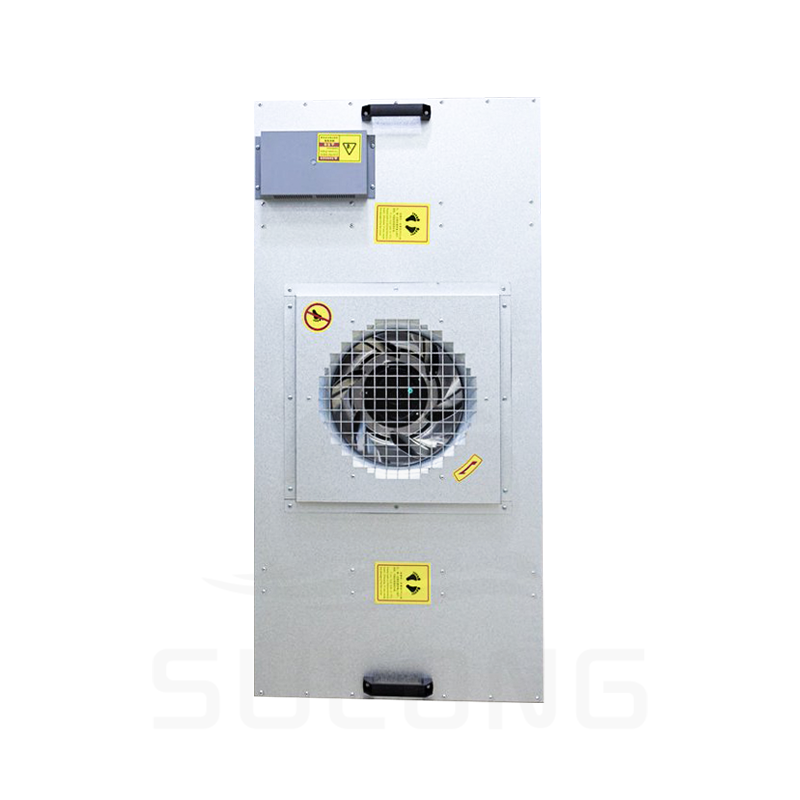
A fan filter unit is essentially a mini air-handling system housed in a compact box, typically installed in the ceiling grid of a cleanroom. It pulls in air from above the ceiling, usually from a plenum space, and pushes it through a HEPA or ULPA filter before releasing it downward into the room in a smooth, uniform stream. This process, known as unidirectional or laminar airflow, continuously washes the room with clean air and pushes particles toward return vents near the floor.
Unlike centralized HVAC systems that filter air at one location and distribute it through ductwork, FFUs bring filtration directly to the point of use. Each unit operates independently with its own fan motor, which means airflow can be adjusted room by room or even zone by zone within the same facility. This modular approach gives facility managers far more flexibility than a single, large air handling unit ever could.
While designs vary slightly between manufacturers, most fan filter units share the same core components working together to produce clean, steady airflow.
Fan filter units are found anywhere airborne contamination could compromise product quality, safety, or research accuracy. Their modular nature makes them adaptable to small lab spaces as well as massive industrial cleanrooms.
Microchip fabrication requires some of the strictest cleanroom standards in existence, since even a single dust particle can ruin a wafer. FFUs are arranged in dense ceiling grids to create ISO Class 1 to 5 environments where airflow is nearly 100 percent unidirectional.
Sterile drug manufacturing and biologics production depend on FFUs to maintain aseptic conditions in filling lines, compounding areas, and quality control labs. Regulatory bodies often specify exact air change rates that facilities must meet, and FFUs make it easier to hit those numbers consistently.
Operating rooms, isolation wards, and research labs use fan filter units to reduce airborne pathogens and protect both patients and sensitive experiments from contamination.
Not every cleanroom needs the same airflow coverage or filter grade. The required cleanliness level, measured by ISO classification, determines how many FFUs are needed per square foot of ceiling space and how fast the air needs to move.
| ISO Class | Typical Ceiling Coverage | Recommended Filter Grade |
| ISO 3 to 4 | 80 to 100 percent | ULPA |
| ISO 5 | 60 to 80 percent | HEPA |
| ISO 6 to 7 | 25 to 40 percent | HEPA |
| ISO 8 | 10 to 15 percent | HEPA |
Higher ceiling coverage generally means tighter particle control, since more of the room's air is being actively filtered at any given moment.
One of the biggest shifts in fan filter unit technology over the past decade has been the move from traditional AC motors to EC (electronically commutated) motors. EC motors offer precise speed control, quieter operation, and significantly lower energy consumption, which matters a great deal when hundreds of units are running continuously in a large facility. Many modern FFUs also include built-in monitoring systems that report airflow velocity, filter pressure drop, and motor status to a central building management system, allowing facility teams to catch filter clogging or motor issues before they cause a contamination event.
Getting the layout right matters just as much as choosing quality units. Poor placement can create dead zones with weak airflow or turbulence that stirs up particles instead of removing them.
Like any mechanical equipment, fan filter units need regular attention to keep performing at their rated efficiency. Filters gradually load up with captured particles, which increases resistance and forces the fan motor to work harder. Left unchecked, this raises energy costs and can eventually reduce airflow below the level required for the room's cleanliness class. Routine maintenance should include periodic airflow velocity checks, visual inspection of filter media for damage, and monitoring pressure drop readings to determine when a filter replacement is due. Most HEPA filters in a well-maintained FFU last several years, but actual lifespan depends heavily on the ambient dust load and how many hours per day the unit runs.
Because cleanrooms often run FFUs around the clock, energy consumption adds up quickly across a large installation. Choosing units with EC motors, variable speed controls, and low-pressure-drop filters can meaningfully cut electricity costs over the equipment's lifetime. Some facilities also implement demand-based control strategies, slowing down FFUs in unoccupied areas during off-hours while ramping them back up before production resumes. This kind of dynamic control balances contamination control with practical energy savings, which matters more and more as facilities scale up their cleanroom square footage.
Choosing the right fan filter unit comes down to understanding your cleanroom's classification requirements, ceiling layout, and long-term operating budget. A well-selected and properly maintained FFU system keeps particle counts under control, supports regulatory compliance, and reduces the risk of costly contamination events. With energy-efficient motors and smart monitoring now standard in many models, today's fan filter units offer better performance and lower running costs than earlier generations, making them a smart long-term investment for any cleanroom facility.

Follow Us:
 Call us :
  Mail us to:


 English
 中文简体
中文简体